
LongPot Village: Rendezvous with Air America
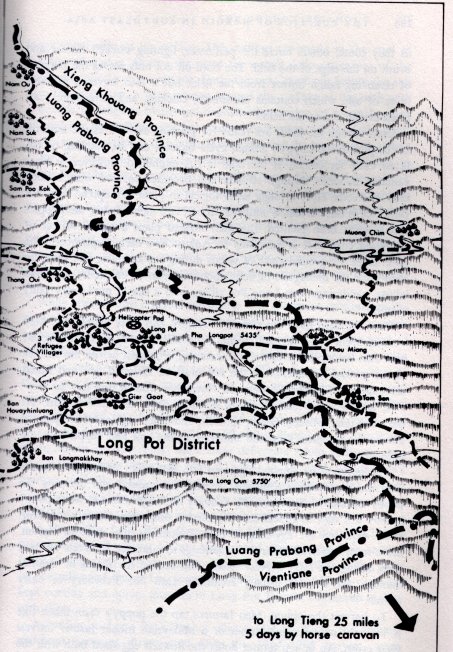
Long PotDistrict, thirty miles northwest of Long Tieng, was one of the last remainingareas in northeastern Laos where the recent history of the opium trafficcould be investigated. Located forty miles due west of the Plain of Jars,it was close enough to Long Tieng to be a part of Gen. Vang Pao's domainbut far enough away from the heavy fighting to have survived and tell itsstory. Viewed from Highway 13, which forms its western boundary, Long PotDistrict seems a rugged, distant world. Phou Phachau mountain, castingits shadow over the entire district, juts more than sixty-two hundred feetinto the clouds that perennially hover about its peak during the mistyrainy season from May to October. Steep ridges radiate outward from PhouPhachau and lesser peaks, four thousand and five thousand feet high, formhollows and valleys that gouge the district's hundred square miles of territory.The landscape was once verdant with virgin hardwood forests, but generationsof slash-and-burn agriculture by hill tribe residents have left many ofthe ridges and valleys covered with tough, chest-high savanna grass.(135)
The district'stwelve villages, seven Meo and five Lao Theung, cling to ridges and mountaincrests, where they command a watchful view of the surrounding countryside.The political center of the district is the village of Long Pot, a Meocommunity of fortyseven wooden, dirtfloored houses and some three hundredresidents. It is not its size, but its longevity which makes Long Pot villageimportant. Founded in the latter half of the nineteenth century, it isone of the oldest Meo villages in northeastern Laos. Its leaders have atradition of political power, and the highest-ranking local official, DistrictOfficer Ger Su Yang, resides in Long Pot village. While most Meo are forcedto abandon their villages every ten or twenty years in search of new opiumfields, Long Pot village is surrounded by a surplus of fertile, limestone-ladenslopes that have allowed its inhabitants to remain in continuous residencefor three generations. Moreover, Long Pot village's high altitude is idealfor poppy cultivation; the village itself is forty-two hundred feet highand is surrounded by ridges ranging up to fifty-four hundred feet. TheYunnan variety of the opium poppy found in Southeast Asia requires a temperateclimate; it can survive at three thousand feet, but thrives as the altitudeclimbs upward to five thousand feet.
Despiteall the damage done by over ten years of constant warfare, opium productionin Long Pot village had not declined. In an August 1971 interview, thedistrict officer of Long Pot, Ger Su Yang, said that most of the householdsin the village had been producing about fifteen kilos of opium apiece beforethe fighting began, and had maintained this level of production for thelast ten years. However, rice production had declined drastically.(136)During a time of war, when the Meo of Long Pot might have been expectedto concentrate their dwindling labor resources on essential food production,they had chosen instead to continue cash-crop opium farming. Guaranteedan adequate food supply by Air America's regular rice drops, the villagerswere free to devote all their energies to opium production. And since VangPao's officers have paid them a high price for their opium and assuredthem a reliable market, the farmers of Long Pot village have consistentlytried to produce as much opium as possible.
In thepast rice has always been the Meo's most important subsistence crop andopium their traditional cash crop. However, opium and rice have conflictingcrop cycles and prosper in different kinds of fields. Because the averageMeo village has a limited amount of manpower, it is only capable of clearinga few new fields every year, and therefore must opt for either opium orrice. When the opium price is high Meo farmers concentrate their effortson the opium crop and use their cash profits to buy rice, but if the pricedrops they gradually reduce poppy cultivation and increase subsistencerice production. With rice from Air America and good opium prices fromVang Pao's officers, the farmers of Long Pot had chosen to emphasize opiumproduction. (137)
Every spring,as the time for cutting new fields approaches, each household sends outa scouting party to scour the countryside for suitable field locations.Since Long Pot Meo want to plant opium, they look for highly alkaline soilnear the ridgeline or in mountain hollows where the opium poppies prosper,rather than mid-slope fields more suitable for rice. The sweeter "taste"of limestone soil can actually be recognized by a discriminating palate,and as they hike around the nearby mountains Meo scouts periodically chewon a bit of soil to make sure that the prospective site is alkaline enough. (138)
Meo farmersbegin clearing their new fields in March or April. Using iron-bitted axes,the men begin chopping away at timber stands covering the chosen site.Rather than cutting through the thick roots or immense trunks of the largertrees, the Meo scale the first twenty feet of the trunk, balance themselveson a slender notched pole, and cut away only the top of the tree. A skilledwoodsman can often fell three or four smaller trees with a single blowif be topples a large tree so that it knocks down the others as it crashesto the ground. The trees are left on the ground to dry until April or earlyMay, when the Meo are ready for one of the most awesome spectacles in themountainsthe burn-off.(139)
| |
When the timberhas become tinderbox dry, the villagers of Long Pot form fire brigadesand gather near the fields on the chosen day. While the younger men ofthe village race down the slope igniting the timber as they come, otherscircle the perimeter, lighting stacked timber and brush on the edge ofthe field. The burn-off not only serves the purpose of removing fallentimber from the field, but it also leaves a valuable layer of ash, whichcontains phosphate, calcium, and potassium, scattered evenly across thefield. (140)
Even thoughthe fields are ready for planting as soon as the burn-off is completed,the poppy's annual cycle dictates that its planting be delayed until September.If the land is left unplanted, however, it loses valuable minerals througherosion and becomes covered with a thick crop of weeds. Here it might seemlogical to plant dry upland rice, but since rice is not harvested untilNovember, two months after the poppies should have been planted, the Meoinstead plant a hardy variety of mountain corn that is harvested in Augustand early September. The corn keeps the ground clear of weeds during thesummer, and provides fodder for the menagerie of hogs, mountain ponies,chickens, and cows whose wanderings turn Long Pot village into a sea ofmud every rainy season.(141)
Once thecorn has been picked in August and early September, Meo women begin choppingand turning the soil with a heavy, triangular hoe. Just before the poppyseeds are sown broadcast across the surface of the ground in September,the soil must be chopped fine and raked smooth with a bamboo broom. InNovember women thin out the poppies, leaving the healthier plants standingabout six inches apart. At the same time tobacco, beans, spinach, and othervegetables are planted among the poppies; they add minerals to the soiland supplement the Meo diet. (142)
The poppiesare thinned again in late December and several weeks later the vegetablesare picked, clearing the ground and allowing the poppy to make its finalpush. By January the bright red and white poppy flowers will start to appearand the harvest will begin, as the petals drop away exposing an eggshapedbulb containing the resinous opium. Since most farmers stagger their plantingsto minimize demands on their time during the busy harvest season and reducethe threat of weather damage, the harvest usually continues until lateFebruary or early March.(143)
To harvestthe opium, Meo farmers tap the poppy's resin much like a Vermont maplesugar farmer or a Malaysian rubber farmer harvest their crops. An opiumfarmer holds the flower's egg-sized bulb with the fingers of one hand whilehe uses a three-bladed knife to incise shallow, longitudinal slits on itssurface. The cuttings are made in the cool of the late afternoon. Duringthe night the opium resin oozes out of the bulb and collects on its surface.Early the next morning, before the sun drys the moist sap, a Meo womanscrapes the surface of the bulb with a flexible rectangular blade and depositsthe residue in a cup hanging around her neck. When she has finished harvestinga kilo of the dark, sticky sap she wraps it in banana leaves and ties thebundle with string.
By thetime the harvest is finished, the forty-seven households in Long Pot villagehave collected more than seven hundred kilos of raw opium. (144)Since Golden Triangle opium is usually 10 percent morphine by weight, theLong Pot harvest will yield roughly seventy kilos of pure morphine baseafter it has been boiled, processed, and pressed into bricks. Once themorphine has been chemically bonded with acetic anhydride in one of theregion's many heroin laboratories, Long Pot's innocent opium harvest becomesseventy kilos of highgrade no. 4 heroin.
While internationalcriminal syndicates reap enormous profits from the narcotics traffic, theMeo farmers are paid relatively little for their efforts. Although opiumis their sole cash crop and they devote most of their effort to it, Meofarmers only receive $400 to $600 for ten kilos of raw opium. After theopium leaves the village, however, the value of those ten kilos beginsto spiral upward, Ten kilos of raw opium yield one kilo of morphine baseworth $500' in the Golden Triangle. After being processed into heroin,one kilo of morphine base becomes one kilo of no. 4 heroin worth $2,000to $2,500 in Bangkok. In San Francisco, Miami, or New York, the courierdelivering a kilo of heroin to a wholesaler receives anywhere from $18,000to $27,000. Diluted with quinine or milk sugar, packaged in forty-fivethousand tiny gelatin capsules and sold on the streets for $5 a shot, akilo of heroin that began as $500 worth of opium back in Long Pot is worth$225 '000. (145)
In the1950s Long Pot's farmers had sold their opium to Chinese caravans fromthe Plain of Jars that passed through the area several times during everyharvest season. Despite the occupation of the plain by neutralist and PathetLao forces in 1960 and 1961, Chinese caravans kept coming and opium growersin Long Pot District continued to deal with them.
Accordingto Long Pot's district officer, Ger Su Yang, the Chinese merchant caravansdisappeared after the 1964-1965 harvest, when heavy fighting broke outon the plain's western perimeter, But they were replaced by Meo army caravansfrom Long Tieng. Commanded by lieutenants and captains in Vang Pao's army,the caravans usually consisted of half a dozen mounted Meo soldiers anda string of shaggy mountain ponies loaded with trade goods. When the caravansarrived from Long Tieng they usually stayed at the district officer's housein Long Pot village and used it as a headquarters while trading for opiumin the area. Lao Theung and Meo opium farmers from nearby villages, suchas Gier Goot and Thong Oui, carried their opium to Long Pot and haggledover the price with the Meo officers in the guest corner of Ger Su Yang'shouse. (146)While the soldiers weighed the opium on a set of balance scales and burneda small glob to test its morphine content (a good burn indicates a highmorphine content), the farmer inquired about the price and examined thetrade goods spread out on the nearby sleeping platform (medicines, salt,iron, silver, flashlights, cloth, thread, etc.). After a few minutes ofcarefully considered offers and counteroffers, a bargain was struck. Atone time the Meo would accept nothing but silver or commodities. However,for the last decade Air America has made commodities so readily availablethat most opium farmers now prefer Laotian government currency. (Vang Pao'sMeo subjects are unique in this regard. Hill tribesmen in Burma and Thailandstill prefer trade goods or silver in the form of British India rupees,French Indochina piasters, or rectangular bars.)(147)
To buyup opium from the outlying areas, the Meo soldiers would leave Long Potvillage on short excursions, hiking along the narrow mountain trails toMeo and Lao Theung villages four or five miles to the north and south.For example, the headman of Nam Suk, a Lao Theung village about four milesnorth of Long Pot, recalls that his people began selling their opium harvestto Meo soldiers in 1967 or 1968. Several times during every harvest season,five to eight of them arrived at his village, paid for the opium in papercurrency, and then left with their purchases loaded in backpacks. Previouslythis village had sold its opium to Lao and Chinese merchants from VangVieng, a market town on the northern edge of the Vientiane Plain. But theMeo soldiers were paying 20 percent more, and Lao Theung farmers were onlytoo happy to deal with them.(148)
Since Meosoldiers paid almost sixty dollars a kilo, while merchants from Vang Viengor Luang Prabang only paid forty or fifty dollars, Vang Pao's officerswere usually able to buy up all of the available opium in the districtafter only a few days of trading. Once the weight of their purchases matchedthe endurance limits of their rugged mountain ponies, the Meo officerspacked it into giant bamboo containers, loaded it on the ponies and headedback for Long Tieng, where the raw opium was refined into morphine base.Meo army caravans had to return to Long Pot and repeat this procedure twoor three times during every season before they had purchased the district'sentire opium harvest.
However,during the 1969-1970 opium harvest the procedure changed. Long Pot's districtofficer, Ger Su Yang, described this important development in an August19, 1971, interview:
"Meoofficers with three or four stripes [captain or major] came from Long Tiengto buy our opium. They came in American helicopters, perhaps two or threemen at one time. The helicopter leaves them here for a few days and theywalk to villages over there [swinging his arm in a semicircle in the directionof Gier Goot, Long Makkhay and Nam Pac], then come back here and radioedLong Tieng to send another helicopter for them. They take the opium backto Long Tieng.
Ger SuYang went on to explain that the helicopter pilots were always Americans,but it was the Meo officers who stayed behind to buy up the opium. Theheadman of Nam Ou, a Lao Theung village five miles north of Long Pot, confirmedthe district officer's account; he recalled that in 1969-1970 Meo officerswho had been flown into Tam Son village by helicopter hiked into his villageand purchased the opium harvest. Since the thirty households in his villageonly produced two or three kilos of opium apiece, the Meo soldiers continuedon to Nam Suk and Long Pot."(149)
AlthoughLong Pot's reluctant alliance with Vang Pao and the CIA at first broughtprosperity to the village, by 1971 it was weakening the local economy andthreatening Long Pot's very survival. The alliance began in 1961 when Meoofficers visited the village, offering money and arms if they joined withVang Pao and threatening reprisals if they remained neutral. Ger Su Yangresented Vang Pao's usurpation of Touby Lyfoung's rightful position asleader of the Meo, but there seemed no alternative to the village declaringits support for Vang Pao.(150)During the 1960s Long Pot had become one of Vang Pao's most loyal villages.Edgar Buell devoted a good deal of his personal attention to winning thearea over, and USAID even built a school in the village.(151)In exchange for sending less than twenty soldiers to Long Tieng, most ofwhom were killed in action, Long Pot village received regular rice drops,money, and an excellent price for its opium.
But in1970 the war finally came to Long Pot. With enemy troops threatening LongTieng and his manpower pool virtually exhausted, Vang Pao ordered his villagesto send every available man, including even the fifteen-year-olds. GerSu Yang complied, and the village built a training camp for its sixty recruitson a nearby hill. Assisted by Meo officers from Long Tieng, Ger Su Yangpersonally supervised the training, which consisted mainly of running upand down the hillside. After weeks of target practice and conditioning,Air America helicopters began arriving late in the year and flew the youngmen off to battle.
Villageleaders apparently harbored strong doubts about the wisdom of sending offso many of their young men, and as early rumors of heavy casualties amongthe recruits filtered back, opposition to Va g Pao's war stiffened. WhenLong Tieng officials demanded more recruits in January 1971 the villagerefused. Seven months later Ger Su Yang expressed his determination notto sacrifice any more of Long Pot's youth:
"Lastyear I sent sixty [young men] out of this village. But this year it's finished.I can't send any more away to fight.... The Americans in Long Tieng saidI must send all the rest of our men. But I refused. So they stopped droppingrice to us. The last rice drop was in February this year."(152)
In JanuaryLong Tieng officials warned the village that unless recruits were forthcomingAir America's rice drops would stop. Although Long Pot was almost totallydependent on the Americans for its rice supply, hatred for Vang Pao wasnow so strong that the village was willing to accept the price of refusal."Vang Pao keeps sending the Meo to be killed," said Ger Su Yang. "Too manyMeo have been killed already, and he keeps sending more. Soon all willbe killed. but Vang Pao doesn't care." But before stopping the shipmentsLong Tieng officials made a final offer. "If we move our village to BanSon or Tin Bong [another resettlement area] the Americans will give usrice again," explained Ger Su Yang. "But at Ban Son there are too manyMeo, and there are not enough rice fields. We must stay here, this is ourhome."153
When theannual Pathet Lao-North Vietnamese offensive began in January 1971, strongPathet Lao patrols appeared in the Long Pot region for the first time inseveral years and began making contact with the local population. Afraidthat the Meo and Lao Theung might go over to the Pathet Lao, the Americansordered the area's residents to move south and proceeded to cut off ricesupport for those who refused to obey.(154)A far more powerful inducement was added when the air war bombing heatedup to the east of Long Pot District and residents became afraid that itwould spread to their villages. To escape from the threat of being bombed,the entire populations of Phou Miang and Muong Chim, Meo villages fivemiles east of Long Pot, moved south to the Tin Bong resettlement area inearly 1971. At about the same time, many of the Meo residents of Tam Sonand eight families from Long Pot also migrated to Tin Bong. Afraid thatPathet Lao patrols operating along Route 13 might draw air strikes on theirvillages, the Meo of Sam Poo Kok joined the rush to Tin Bong, while threeLao Theung villages in the same general area-Nam Suk, Nam Ou and San Pakau-movedto a ridge opposite Long Pot village. Their decision to stay in Long PotDistrict rather than move south was largely due to the influence of GerSu Yang. Determined to remain in the area, he used all his considerableprestige to stem the tide of refugees and retain enough population to preservesome semblance of local autonomy. Thus rather than moving south when facedwith the dual threat of American air attacks and gradual starvation, mostof the villagers abandoned their houses in January and hid in the nearbyforest until March.
While U.S.officials in Laos claim that hill tribes move to escape slaughter at thehands of the enemy, most of the people in Long Pot District say that itis fear of indiscriminate American and Laotian bombing that has driventheir neighbors south to Tin Bong. These fears cannot be dismissed as ignoranceon the part of "primitive" tribes; they have watched the air war at workand they know what it can do. From sunrise to sunset the mountain silenceis shattered every twenty or thirty minutes by the distant roar of pairedPhantom fighters enroute to targets around the Plain of Jars. Throughoutthe night the monotonous buzz of prowling AC-47 gunships is broken onlywhen their infrared sensors sniff warm mammal flesh and their minigunsclatter, spitting out six thousand rounds a minute. Every few days a handfulof survivors fleeing the holocaust pass through Long Pot relating theirstories of bombing and strafing. On August 21, 1971, twenty exhausted refugeesfrom a Lao Theung village in the Muong Soui area reached Long Pot village.Their story was typical. In June Laotian air force T-28s bombed their villagewhile they fled into the forest. Every night for two months AC-47 gunshipsraked the ground around their trenches and shallow caves. Because of thedaylight bombing and nighttime strafing, they were only able to work theirfields in the predawn hours. Finally, faced with certain starvation, theyfled the Pathet Lao zone and walked through the forest for eleven daysbefore reaching Long Pot. Twice during their march the gunships found themand opened fire.(155)
When GerSu Yang was asked which he feared most, the bombing or the Pathet Lao,his authoritative confidence disappeared and he replied in an emotional,quavering voice, The bombs! The bombs! Every Meo village north of here[pointing to the northeast] has been bombed. Every village! Everything!There are big holes [extending his arms] in every village. Every houseis destroyed. If bombs didn't hit some houses they were burned. Everythingis gone. Everything from this village, all the way to Muong Soui and allof Xieng Khouang [Plain of Jars] is destroyed. In Xieng Khouang there arebomb craters like this [stretching out his arm, stabbing into the air toindicate a long line of craters] all over the plain. Every village in MengKhouang has been bombed, and many, many people died. From here . . . allthe mountains north have small bombs in the grass. They were dropped fromthe airplanes.(156)
Althoughopium production in Long Pot village had not yet declined, by August 1971there was concern that disruption caused by the escalating conflict mightreduce the size of the harvest. Even though the village spent the 1970-1971harvest season hiding in the forest, most families somehow managed to attaintheir normal output of fifteen kilos. Heavy fighting at Long Tieng delayedthe arrival of Air America helicopters by several months, but in May 1971they finally began landing at Long Pot carrying Meo army traders, who paidthe expected sixty dollars for every kilo of raw opium. (157)
However,prospects for the 1971-19 2 opium harvest were looking quite dismal asplanting time approached in late August. There were plenty of women toplant, weed, and harvest, but a shortage of male workers and the necessityof hiding in the forest during the past winter had made it difficult forhouseholds to clear new fields. As a result, many farmers were plantingtheir poppies in exhausted soil, and they only expected to harvest halfas much opium as the year before.
However,as the war mounted in intensity through 1971 and early 1972, Long Pot District'sopium harvest was drastically reduced and eventually destroyed. USAID officialsreported that about forty-six hundred hill tribesmen had left the districtin January and February 1971 and moved to the Tin Bong refugee area tothe south, where there was a shortage of land. (158)Some of the villages that remained, such as the three Lao Theung villagesnear Long Pot village, were producing no opium at all. Even Long Pot villagehad lost eight of its households during the early months of 1971. Finally,on January 4, 1972, Allied fighter aircraft attacked Long Pot District.In an apparent attempt to slow the pace of a Pathet Lao offensive in thedistrict, the fighters napalmed the district's remaining villages, destroyingLong Pot village and the three nearby Lao Theung villages. (159)