|
The Akha Heritage Foundation - www.akha.org
Akha Human Rights - Akha University
| ||||||||||||||
 
|
Document
You may copy and save this document for later reading.
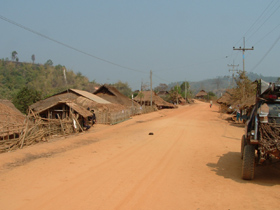
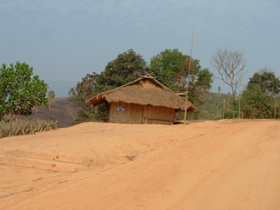
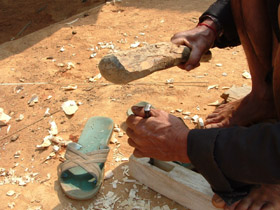
Please remember to do a site search for other related documents which may not be shown here. Gow Lang 2 Eleven huts line both sides of the road making up one of the poorest dustiest villages in this area. At the one end of the village the Chinese American Baptist missionaries have built a missionizing hut to try and convert the village away from their traditional life. A wire runs from the hut of one of the first persuaded to convert. Always the story is that they are just there to teach the kids how to write in Akha and save the culture. The lies get increasingly complex and manipulative. They seem to forget that they only book they are going to supply in Akha language is the bible. The missions harvest the villages as a resource no different than any other. Taking another man's corn, corn they didn't plant, changing children's minds to abandon who they are, Akha, and give control to the missionaries. No wealth or health is brougth to the village, only lies and propaganda. So far three villagers have fallen to the scam. The village is hot and dusty. Clouds of dust roll across the huts as trucks roar up the road towards Hua Mae Kom, some ten kilometers further to the end of this part of Thailand. An old man chisels a mortice in a piece of wood. He's making a new door for the house. "People coming and going, my door always gets torn apart," he says. "Making a good one!" Eight families are still traditional. The mission is after everyone. Few christian villages allow even a couple huts to stay traditional while by comparison the traditional Akah will allow christian families to stay in their village, though the radical, disruptive and divisive methods of the missionaries brings anger and fighting to the village. Many villages are split. A village that is being split by the missions is always at stress, and a converted village is a village of Akha who have given up. The villagers say that many coffee plants have died this year because there hasn't been rain for five months. The brown dust on everything emphasizes his words. I move into the shade to get out of the morning sun, already burning through my shirt. An old man next to me tells me he's 85 years old. He's seen it all at least once I figure. "We only know how to farm," he tells me. A boy in a red shirt tells me he is in the village mid day because he doesn't have enough money to go anywhere and there isn't any work. A few fields are ready, waiting for the rain and planting. An old woman on the other side of the road is all dressed out in Akha clothes. She has to work. She is old. Her husband is old. She has only one son. He isn't married yet. There is no one else to feed them. A happy talkativeman sits nearby. Laughter a respite for the misery and hopelessness. They only ahve a few fields he says. There is a small trickle of water into the village cistern. Gow Lang 1 Akha village is over on another hill nearby, a different village, a different set of problems, yet the dirge of sad music blends together in all the tragedies. An old woman sits on an a porch, repairing her head dress, adding beads and coins for those damaged or lost. I drive slowly out of the village, wishing I had some fruit trees to offer. Anything.
Copyright 1991 The Akha Heritage Foundation | |||||||||||||