|
The Akha Heritage Foundation - www.akha.org
Akha Human Rights - Akha University
| ||
 
|
Document
You may copy and save this document for later reading.
Please remember to do a site search for other related documents which may not be shown here. Akha Traditional Oral Literature
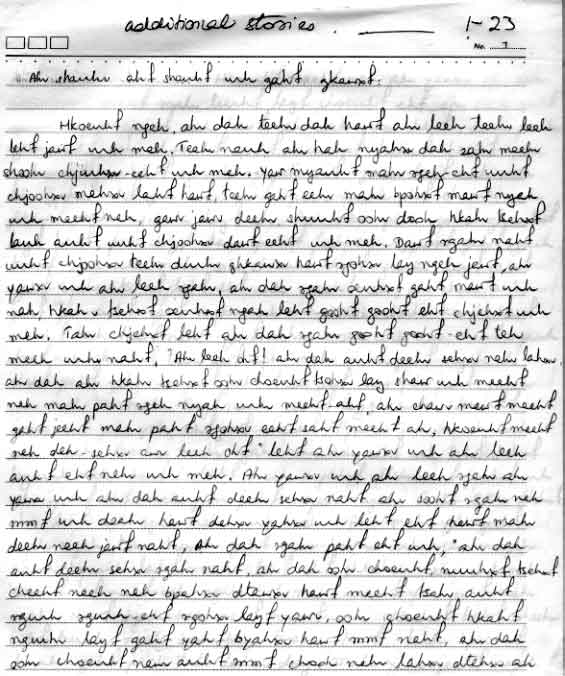
See the list of image links at bottom for original texts.
The Akhas are a hilltribe who cultivate rice in the hills stretching from Thailand and Burma to China, Vietnam, and Laos They have a rich traditional literature passed down from generation to generation orally. Over the years scholars at universities have been too busy with ego wars, petty political infighting, and a misplaced sense of perfectionism to do the one thing that really needs doing: PRESERVATION before these texts locked in the brains of Akha elders disappear. After year 2000 there has been a torrent of evangelical protestant missionaries to the Golden Triangle region, the areas where the Akhas reside. Unlike the Catholics who have been in this region for 100 years and cultivate great tolerance for local culture, the evangelical missionaries aim to destroy Akha culture. They tear down the traditional village gates because they have "heathen idols" and banish the traditional Akha shaman or priest because he is the repository of "heathen texts". This project seeks to put as much of the Akha oral tradition online for free use by both Akhas, scholars, and motivated amateurs as possible. It takes the position that these texts are one of the most important tools that Akhas can use to maintain their own identity and avoid getting swept up and eliminated as a distinct and proud people by the various nation states that they happen to reside in.
Preservation Project Stages:Stage 1: Oral Literature to Written Transcriptions: Over the last five years Matthew McDaniel has raised money for native Akha scholars from Burma to transcribe traditional Akha oral literature into written form. This collection of texts includes songs, stories, ceremonies and the traditional law that governs life in Akha villages in Laos, China, Burma, and Thailand. This stage has already been completed. [ Some sample texts from this stage].
Stage 2. Written Transcriptions to Computer Files: These texts need to be made widely available over the internet, on CD, and in book form. In stage two the collection will be reduced to a set of plain text files and uploaded to a simple internet site. This strategy has been used effectively by the famous "Project Gutenberg" to make an ever-growing library of classic literature from around the world easily available for free.
Stage 3: Filling gaps in the Akha Oral Literature collection: The first step is to videotape a live recital of the Akha law using the same group of akha scholars This should take about one month. The videotape will be transcribed direct to computer files from the videotape. It will take several additional months for this team to paraphrase the texts into contemporary spoken Akha. Most traditional Akha texts are in an archaic dialect of Akha difficult for an Akha layperson to understand.
Stage 4: Translation into English: Preparation of an extensive glossary/dictionary based on the texts and then translation into English.
Online Free TextsIf you are studying Akha language or culture as a research project at a university or actually live among the Akha and need to know more about the language and culture the Akha texts that follow may be useful. They are the beginning of stage 2 in the project described above.
See Download section for PDF Ebook Version
JPEG images (for easy online reading): | |