|
The Akha Heritage Foundation - www.akha.org
Akha Human Rights - Akha University
| ||
 
|
Document
You may copy and save this document for later reading.
Please remember to do a site search for other related documents which may not be shown here. Opium in Laos Alfred McCoy The Politics of Heroin in SE Asia
Laos
Laos
is one of those historical oddities like Monaco, Andorra, and Lichtenstein
which were somehow left behind when petty principalities were consolidated into
great nations. Although both nineteenth-century empire builders and cold war
summit negotiators have subscribed to the fiction of Laotian nationhood out of
diplomatic convenience, this impoverished little kingdom appears to lack all of
the economic and political criteria for nationhood. Not even the Wilsonian principle of ethnic determinism that Versailles
peacemakers used to justify the carving up of the Austro-Hungarian Empire after
World War I validate Laos's existence. Some 8.0 million Lao live in northeast
Thailand, but there are only about 1.5 million Lao in Laos. With a total
population of between 2 and 3 million and singularly lacking in natural
resources, Laos has been plagued by fiscal problems ever since independence in
1954. Unable to finance itself through corporate, mineral, or personal taxes,
the Royal Laotian government has filled its coffers and lined its pockets by
legalizing or tolerating what its neighbors have
chosen to outlaw, much like needy principalities the world over. Monaco
gambles, Macao winks at the gold traffic, and the Laotian government tolerates
the smuggling of gold, guns, and opium. While the credit card revolution has displaced paper currency in most of
suburban America, peasants and merchants in underdeveloped countries still harbor a healthy distrust for their nations' technicolor currency, preferring to store their hard-earned
savings in gold or silver. Asian governments have inadvertently fostered
illicit gold trafficking either by imposing a heavy revenueproducing
duty on legal gold imports or else limiting the right of most citizens to
purchase and hold gold freely; thus, an illicit gold traffic flourishes from
Pakistan to the Philippines. Purchased legally on the European market, the gold
is flown to Dubai, Singapore, Vientiane, or Macao, where local governments have
imposed a relatively low import duty and take little interest in what happens
after the tax is paid. Laos's low duty on imported gold and its government's active participation in the smuggling trade have long made it the major source of illicit gold for Thailand and South Vietnam. Although Laos is the poorest nation in Southeast Asia, Vientiane's licensed brokers have imported from thirty-two to seventy-two tons of gold a year since the American buildup in Vietnam began in 1965. As thousands of free-spending GIs poured into Vietnam during the early years of the war, Saigon's black market prospered and Laos's annual gold imports shot up to seventytwo tons by 1967.(24) The 8.5 percent import duty provided the Royal Lao government with more than 40 percent of its total tax revenues, and the Finance Ministry could not have been happier. (25) However, in 1968 the Tet offensive and the international gold crisis slowed consumer demand in Saigon and plunged the Laotian government into a fiscal crisis. Prime Minister Souvanna Phouma went before the National Assembly and explained that because of the downward trend in the gold market, "one of our principle sources of income will not reach our expectations this year." Faced with what the prime minister described as "an extremely complex and difficult situation," Finance Minister Sisouk na Champassak privately suggested that the government might seek an alternate source of revenue by taxing the clandestine opium trade. (26) When the establishment of a gold market in Singapore in 1969 challenged Laos's position as the major gold entrepot in Southeast Asia and forced the Finance Ministry to drop the import duty from 8.5 to 5.5 percent in 1970, (27) Sisouk na Champassak told a BBC reporter, "The only export we can develop here is opium, and we should increase our production and export of it." (28) As minister of finance and acting minister of defense,
Sisouk is one of the most important government
officials in Laos, and his views on the opium trade are fairly representative
of the ruling elite. Most Laotian leaders realize that their nation's only
valuable export commodity is opium, and they promote the traffic with an
aggressiveness worthy of Japanese electronics executives or German automobile
manufacturers. Needless to say, this positive attitude toward the narcotics
traffic has been something of an embarrassment to American advisers serving in
Laos, and in deference to their generous patrons, the Laotian elite have
generally done their best to pretend that opium trafficking is little more than
a quaint tribal custom.(29)
As a result, violent coups, assassinations, and bitter political
infighting spawned by periodic intramural struggles for control of the
lucrative opium traffic have often seemed clownlike
or quixotic to outside observers. But they suddenly gain new meaning when
examined in light of the economics and logistics of the opium trade. Since the late 1950s the opium trade in northern Laos has involved both
the marketing of the locally grown produce and the transit traffic in Burmese
opium. Traditionally most of Laos's domestic production has been concentrated
in the mountains of northeastern Laos, although it is
now greatly reduced because of massive U.S. bombing and a vigorous opium
eradication program in Pathet Lao liberated zones.(30)
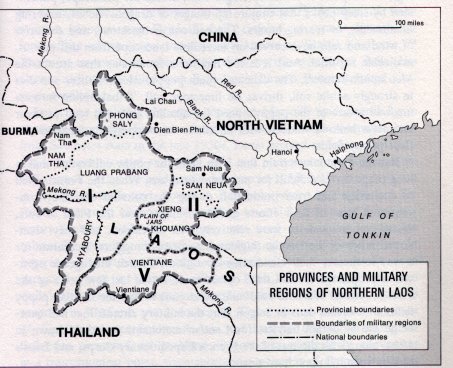
Designated on Royal Lao Army maps as Military Region 11, this area comprises
the Plain of Jars and most of the Meo highlands that
extend from the northern rim of the Vientiane Plain to the border of North
Vietnam. While northwestern Laos also has extensive
poppy cultivation, opium
production has never achieved the same high level as
in the northeast; soil conditions are not as favorable,
the traffic has not been as well organized, and tribal populations are more
scattered. For example, there are between 150,000 and 200,000 Meo living in the northeast, but only about 50,000 Meo in the northwest. As a result, the opium trade in northwestern Laos, now known as Military Region 1, was
always secondary in importance during the colonial era and the early years of
the postcolonial opium traffic. However, in the mid 1960s Shan and Nationalist
Chinese opium caravans began crossing the Mekong into Laos's extreme northwest
with large quantities of Burmese opium. As dozens of refineries began springing
up along the Laotian bank of the Mekong to process the Burmese opium, the center of Laos's opium trade shifted from the Plain of Jars
to Ban Houei Sai in northwestern Laos. The mountains of northern Laos are some of the most strikingly beautiful
in the world. Shrouded with mile-high clouds during the rainy season, they are
strongly reminiscent of traditional Chinese scroll paintings. Row upon row of
sharp ridges wind across the landscape, punctuated by steep peaks that conjure
up images of dragons' heads, towerin monuments,
or rearing horses. The bedrock is limestone, and centuries of wind and rain
have carved an incredible landscape from this porous, malleable material. And
it is the limestone mountains that attract the Meo
opium farmers. The delicate opium poppy, which withers and di
s in strongly acidic soil, thrives on limestone soil. Tribal opium farmers are
well aware of the poppy's need for alkaline soil, and tend to favor mountain hollows studded with limestone outcroppings
as locations for their poppy fields. But the mountain terrain that is so ideal for poppy cultivation makes long-range travel difficult for merchant caravans. When the French tried to encourage hill tribe production during the colonial era, they concentrated most of their efforts on Meo villages near the Plain of Jars, where communications were relatively well developed, and they abandoned much of the Laotian highlands to petty smugglers. Desperate for a way to finance their clandestine operations, French intelligence agencies expropriated the hill tribe opium trade in the last few years of the First Indochina War and used military aircraft to link the Laotian poppy fields with opium dens in Saigon. But the military aircraft that had overcome the mountain barriers for Laotian merchants were withdrawn in 1954, along with the rest of the French Expeditionary Corps, and Laos's opium trade fell upon hard times. Copyright 1991 The Akha Heritage Foundation | |